



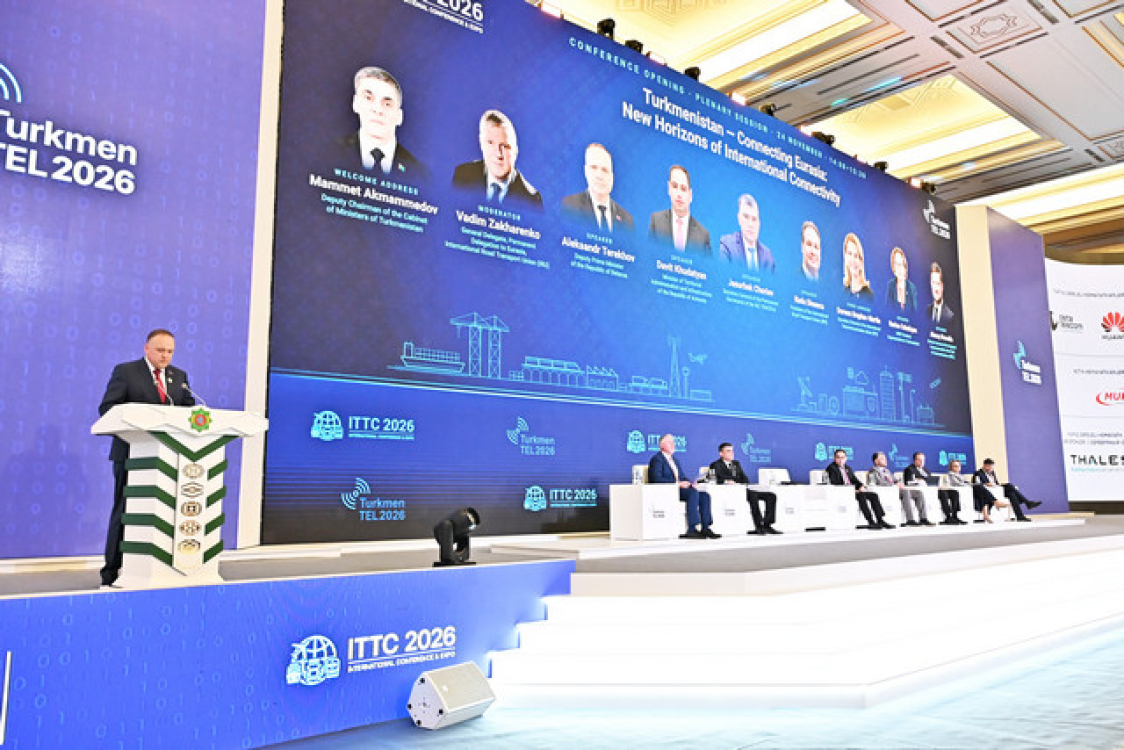
Belarus is keen to expand the use of the eastern route of the ‘North–South’ international transport corridor, which passes through Turkmenistan. This was stated by Alexander Terekhov, Deputy Prime Minister of the Republic of Belarus, at the ‘ITTC 2026’ international conference in Ashgabat, according to the news agency ‘Turkmenistan: Golden age’.
Terekhov noted that the development of international transport corridors is one of Belarus’s key economic priorities. Two of the ten main transport corridors running in the ‘West–East’ and ‘North–South’ directions, which facilitate freight transport between Asia and Europe, pass through the country.
The Deputy Prime Minister also highlighted the convergence of interests between Belarus and Turkmenistan in the development of international transport links. According to Alexander Terekhov, Turkmenistan is a key transport hub in the Caspian region and facilitates the operation of several international corridors.
“At this stage, it is of the utmost importance for Belarus to establish reliable transport routes in a south-easterly direction. In particular, we intend to make more active use of the capacity of the eastern ‘North–South’ route, which passes through Turkmenistan,” stated Alexander Terekhov.
He also noted that, due to cooperation between transport and logistics organisations, shippers and consignees, Belarus is ready to ensure consistent transit of goods along the ‘North–South’ and ‘West–East’ routes.
According to the Belarusian Deputy Prime Minister, the country has established a well-developed terminal infrastructure, enabling the handling and consolidation of various types of cargo in regional centres and major cities.
Concluding his speech, Terekhov outlined the strategic objective of establishing a unified logistics ecosystem across the CIS. In the Deputy Prime Minister’s view, such a system must be based on trust and the mutual recognition of electronic documents, which will enable the creation of a single space for the unimpeded movement of goods.
Read also



Advertising



 Read us in Zen


