

In 2026, Turkmenistan will mark the 35th anniversary of its independence. Over this period, the country has developed its own model of political, socio-economic and cultural development, strengthened its international ties and implemented large-scale infrastructure projects. This was reported by the news agency TDH.
Turkmenistan currently maintains diplomatic relations with 161 states and cooperates with 55 international and regional organisations. The country’s foreign policy is based on the principles of neutrality, equality, mutual respect and mutually beneficial cooperation.
Turkmenistan’s permanent neutrality was recognised by the UN General Assembly in 1995, 2015 and 2025. This status shapes the country’s foreign policy strategy and its participation in international initiatives aimed at strengthening Peace and Trust. On 26 May 2026, Turkmenistan spoke on behalf of the Group of Friends of Neutrality at a high-level open debate in the UN Security Council.
The principle of ‘The State is for the People!’ occupies an important place in state policy. The social orientation of development is reflected, in particular, in the structure of investment: in the first half of 2026, 54.9 per cent of funds utilised were allocated to social and cultural projects, whilst 45.1 per cent went towards industrial facilities.
Since gaining independence, Turkmenistan has been implementing reforms aimed at diversifying the economy, developing the private sector, modernising industry and expanding export potential. Within the framework of national development programmes, particular attention is paid to industrialisation, digital transformation and the introduction of innovative technologies.
The gas sector continues to play a significant role in the economy. The country is developing the gas chemical industry and the production of high value-added products. In Ovadandepe, there is a GTL plant producing Euro-5 standard ECO-93 petrol, liquefied petroleum gas and diesel fuel. Projects to expand natural gas processing are also underway.
The electricity sector is also developing. Turkmenistan meets its domestic needs and exports electricity to neighbouring states. Alongside conventional energy sources, the country is developing renewable energy sources, including a hybrid solar-wind power station project in the Balkan velayat.
In the chemical industry, plants have been established to produce nitrogen and phosphate fertilisers. These include the Garabogaz Urea-Ammonia Plant, the Mary and Tejen Urea Plants, and the Turkmenabat Chemical Plant. Projects to construct new production facilities are being implemented in collaboration with foreign partners.
The textile industry remains one of the key sectors. The country is home to full-cycle enterprises, cotton-spinning and weaving plants, as well as garment, silk-processing and footwear factories. Turkmen textiles are exported to dozens of countries around the world.
Since independence, agriculture has been transformed into a major agro-industrial complex. Reforms are being carried out in the area of management, and market mechanisms and resource-saving technologies are being introduced. The main objectives remain ensuring food security, developing processing and increasing export potential.
Significant changes have taken place in the transport and communications sector. Major projects include the Turkmenbashi International Seaport, Ashgabat International Airport, the ‘Kazakhstan–Turkmenistan–Iran’ railway, the ‘Ashgabat–Turkmenabat’ motorway and the national telecommunications satellite ‘TürkmenÄlem 52°E’. The country continues to develop its transport infrastructure and strengthen its position as a Eurasian transit hub.
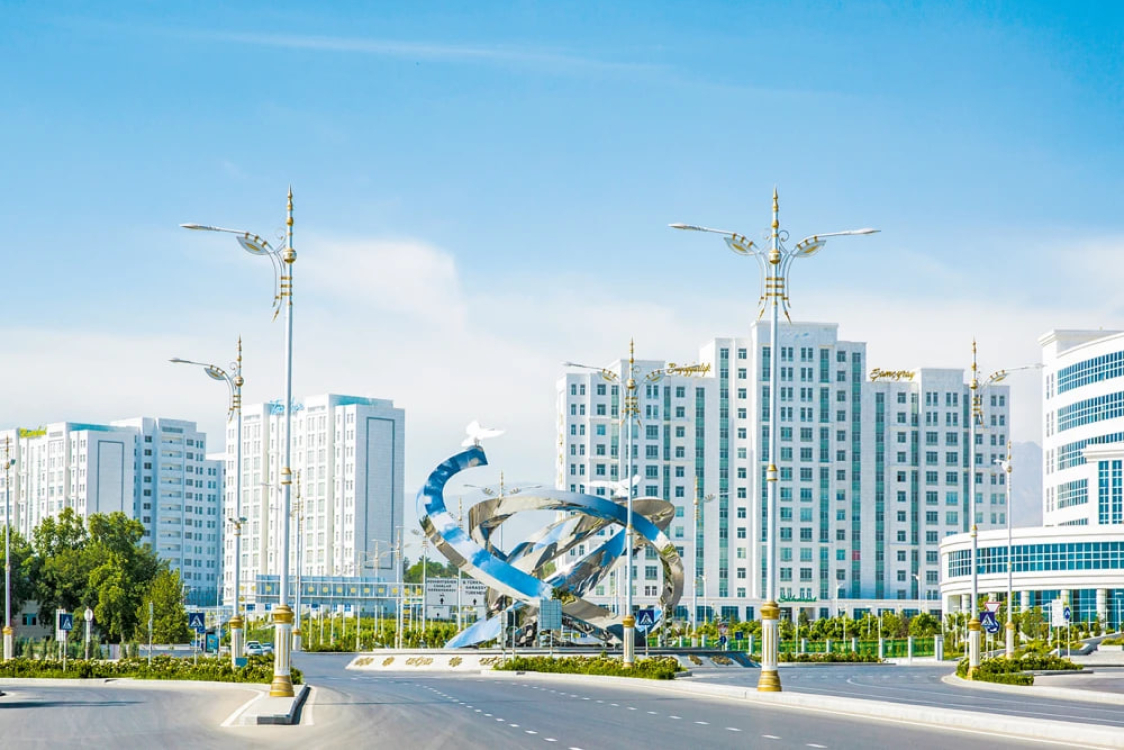
Over the past 35 years, the appearance of Turkmenistan’s towns and villages has changed. New residential complexes, settlements and social facilities have been built in the regions. The city of Arkadag, established on the initiative of the National Leader of the Turkmen people, Gurbanguly Berdimuhamedov, holds a special place. In accordance with the ‘Concept for the Development of the City of Arkadag for 2024–2052’, the construction of the city’s second phase is underway, comprising more than 220 facilities built to digital standards.
The historical and cultural monuments of Ancient Merv, Kunya-Urgench and the fortress of Ancient Nisa are included on the UNESCO World Heritage List. The Representative List of the Intangible Cultural Heritage of Humanity also includes the epic art of ‘Gorogly’, the art of ‘kushtdepdi’, traditional Turkmen carpet-weaving and embroidery, the art of making and playing the dutar, as well as the art of breeding Ahal-Teke horses and the traditions of their adornment.
Thus, over the 35 years of its independence, Turkmenistan has strengthened its international standing, developed its industry, transport and social infrastructure, expanded cultural cooperation and laid the foundations for further economic and social development.
Read also
Advertising
 Read us in Zen


