



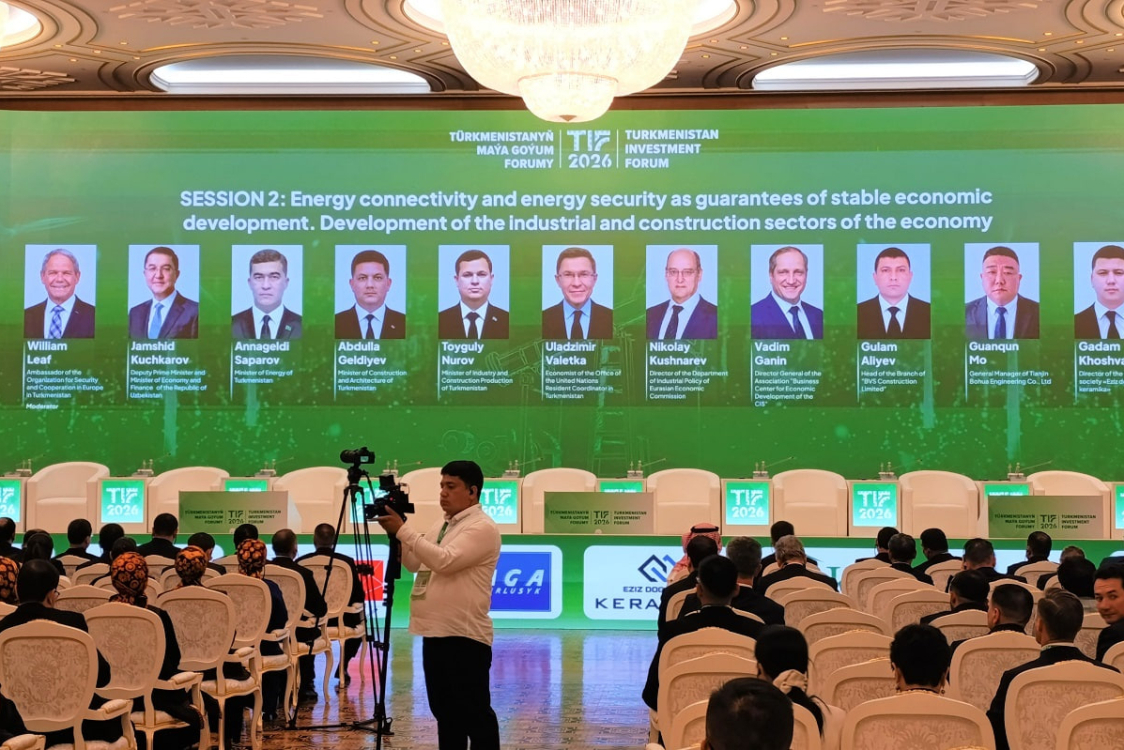
At the second session of the Turkmenistan Investment Forum (TIF 2026), dedicated to energy interconnectivity, security and the development of the industrial and construction sectors, Turkmenistan’s Minister of Energy, Annageldi Saparov, presented plans to modernise the energy sector and expand export routes. This was reported by Orient.
The session was moderated by William Leaf, the Organisation for Security and Co-operation in Europe (OSCE) Ambassador to Turkmenistan. It was also attended by heads of the ministries of construction, architecture and industry, as well as representatives of the UN, the EEC and foreign businesses.
According to the minister, Turkmenistan’s energy system comprises 12 power stations with a total installed capacity of almost 7,000 megawatts. It meets the country’s domestic needs and supplies electricity for export.
Construction has begun on a 1,574 MW combined-cycle power station on the Caspian coast. The project aims to improve the reliability of the power system and expand electricity supplies across the Caspian Sea to the countries of the Caucasus and Turkey.
In the Balkan velayat, a project for a 10-megawatt hybrid solar-wind power station is being implemented in the Gyzylarbat etrap.
Turkmenistan’s Minister of Energy also announced the completion of the Turkmen section of the ‘Turkmenistan–Afghanistan–Pakistan’ (TAP) high-voltage transmission line. The country’s unified ring power system has been expanded to include power lines and substations on the ‘Ahal–Mary’ and ‘Balkan–Dashoguz’ routes, implemented with the participation of the Asian Development Bank.
Annageldi Saparov stated that the ministry was ready to continue negotiations with investors and companies from Europe, Japan, China and the Republic of Korea on issues relating to the digitalisation of management, improving energy efficiency and diversifying electricity exports.
Read also

Advertising




 Read us in Zen


