

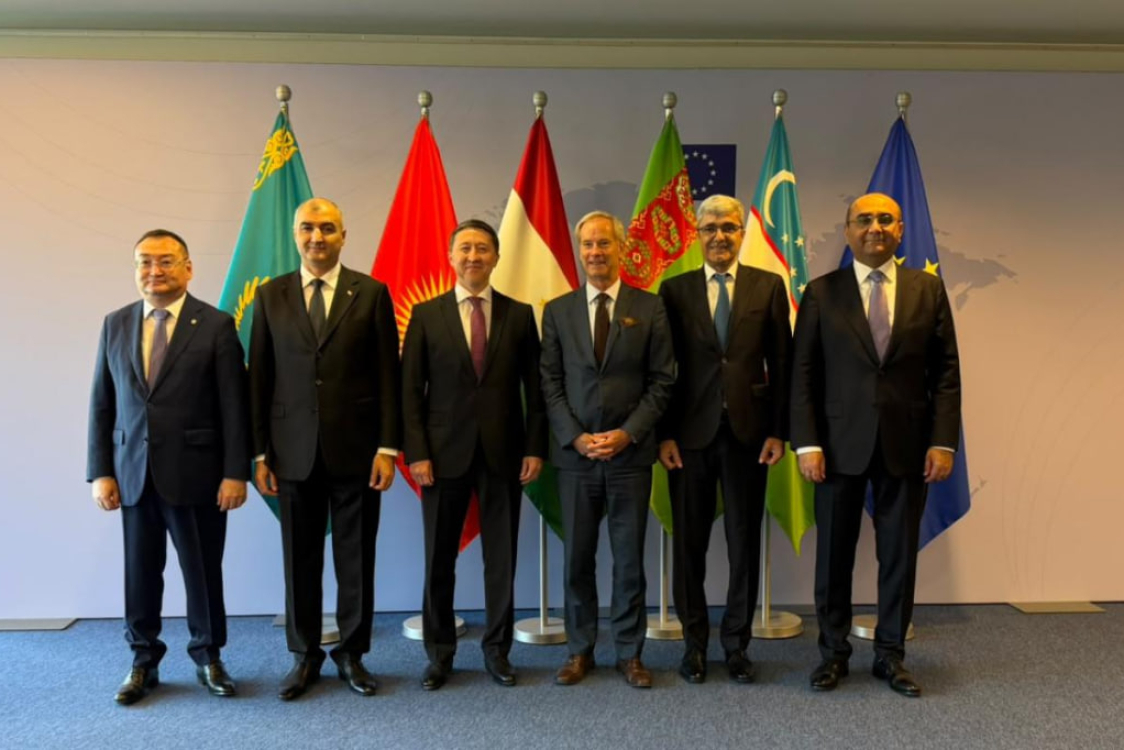
On 16 July, Ahmet Gurbanov, Deputy Foreign Affairs Minister of Turkmenistan, took part in the 13th meeting of the ‘European Union–Central Asia’ High-Level Dialogue on Political and Security Issues in Brussels. This was reported by the press office of the Foreign Affairs Ministry of Turkmenistan.
The participants discussed regional and international security, strengthening resilience, border management, countering modern threats, and developing connectivity and multilateral cooperation.
Ahmet Gurbanov highlighted the importance of the ‘European Union–Central Asia’ format for pooling the potential of the countries in the region and the EU with a view to sustainable development and strengthening regional security. In his view, long-term security must be based on political and diplomatic mechanisms, confidence-building, socio-economic development, respect for international law and multilateral diplomacy, with the United Nations playing a central role.
Turkmenistan reaffirmed its support for the further development of mechanisms for cooperation with the European Union, including the High-Level Political and Security Dialogue, meetings of special representatives and EU practical programmes in the field of security.
A meeting also took place in Brussels between Ahmet Gurbanov and Gilles Bertrand, the European Union’s Special Envoy for Afghanistan and Head of the Afghanistan and Pakistan Division at the European External Action Service. The parties discussed cooperation on Afghanistan, including humanitarian aid, the implementation of transport and energy projects, and collaboration within the framework of the regional CADAP and BOMCA programmes. Particular attention was paid to the coordination of international efforts, with the United Nations playing a central role.
In addition, Ahmet Gurbanov met with Olof Skoog, Deputy Secretary-General for Political Affairs at the European External Action Service. The parties discussed the development of transport connectivity, the potential of the Trans-Caspian Transport Corridor and the European Union’s ‘Global Gateway’ initiative.
Other areas of cooperation mentioned included energy, improving energy efficiency, the development of renewable energy sources, the introduction of modern technologies and the reduction of methane emissions. Education, professional training and academic exchanges were also discussed.
Read also
Advertising
 Read us in Zen


