


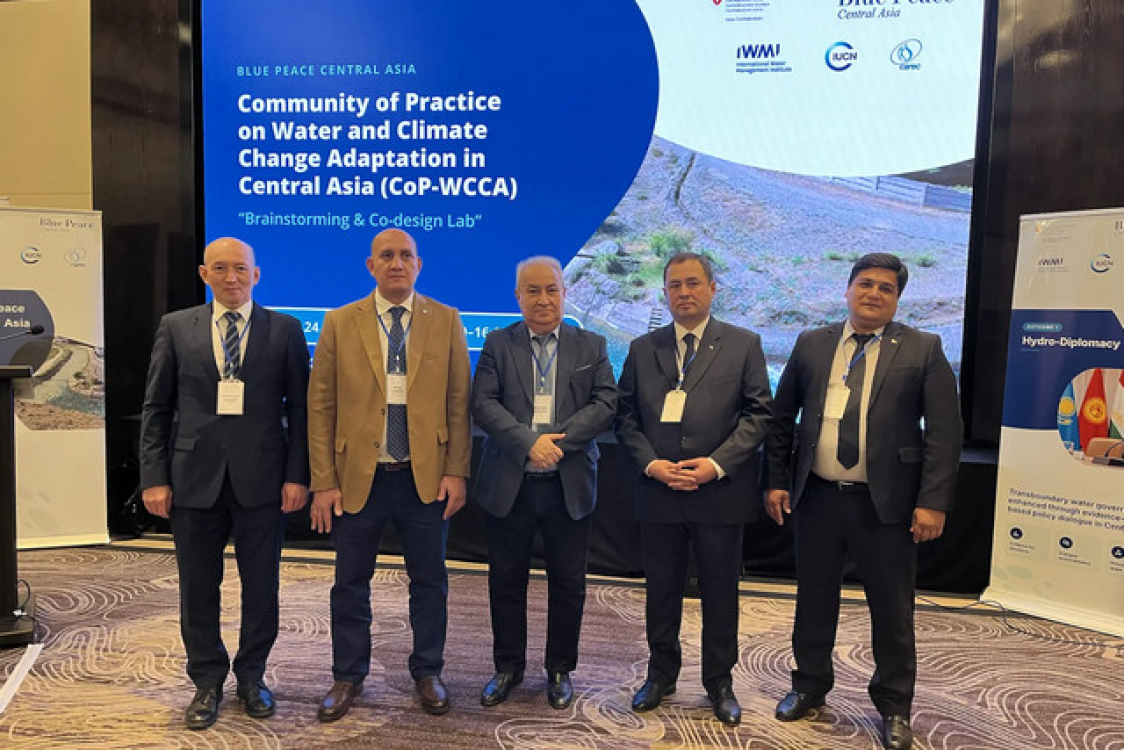
On 24–25 November 2026, regional events were held in Bishkek as part of the international ‘Blue Peace Central Asia’ initiative, organised by the International Water Management Institute (IWMI) and the Regional Environmental Centre for Central Asia (CAREC) with the support of the Swiss Agency for Development and Cooperation. Participants discussed issues of transboundary water resource management, adaptation to climate change, and the preparation of the initiative's work plan for 2027, according to the ‘Turkmenistan: Golden age’ news agency.
One of the key events was the regional seminar ‘From Scientific Data to Shaping Regional Priorities and Making Program Decisions’, held on 25 November as part of the second meeting of the initiative’s Regional Advisory Committee. The day before, a working meeting of the Community of Practice on Water Resources and Climate Change Adaptation in Central Asia (CoP-WCCA) took place.
Turkmenistan was represented by a delegation comprising water management specialists, environmentalists, diplomats and staff from the Centre for Strategic Studies at the Institute of International Relations of the Ministry of Foreign Affairs. The composition of the delegation reflected the country’s comprehensive approach to water security issues, combining scientific, diplomatic and practical perspectives.
For Turkmenistan, the rational use of transboundary waters is of particular importance, as a significant proportion of its water resources originate outside the country, primarily in the Amu Darya basin. Ashgabat advocates resolving water and environmental issues on the basis of international law, taking into account the interests of all states in the basin and through constructive dialogue. UN bodies and the International Fund for Saving the Aral Sea play an important role in this process.
During the conference, a representative of the Centre for Strategic Studies of the Foreign Affairs Ministry of Turkmenistan highlighted the importance of regional platforms for cooperation between the scientific community, relevant ministries and diplomatic bodies. Participants also examined the impact of glacier melt on river flow and water use, noting the need for a comprehensive approach to addressing water issues.
Alongside the development of international cooperation, Turkmenistan is modernising its national water management system. The updated Water Code and the National Climate Change Strategy form the regulatory framework for this work. Particular attention is being paid to reducing water losses in agriculture: the concreting of irrigation canals is continuing, the Karakum River is being modernised, and automated water metering systems are being introduced.
The ‘Altyn Asyr’ Lake in the Karakum Desert remains a major infrastructure project. A system of collectors gathers mineralised drainage water from irrigated land, helping to reduce the risk of salinisation and waterlogging of agricultural land, as well as minimising the discharge of drainage water into the Amu Darya. The collected water can be used for technical purposes and for watering pastures.
In June 2026, the Government of Turkmenistan, in collaboration with the United Nations system, began developing a long-term roadmap entitled ‘Water Scenarios and Foresight (2026–2050)’. The document aims to adapt agriculture and the labour market to the consequences of climate change. Furthermore, updated rules on preferential lending enable agricultural producers to obtain targeted loans for the purchase of drip and sprinkler irrigation systems, pumping equipment and pipelines.
The introduction of modern technologies is being facilitated by joint projects with the UNDP, the FAO, the Asian Development Bank, the Global Environment Facility and the Green Climate Fund. Demonstration plots for drip irrigation, equipped with mini-weather stations and the CROPWAT 8.0 software package, have been established in the Ahal and Dashoguz velayats. The use of these technologies makes it possible to calculate the water and fertiliser requirements of crops, reducing water consumption by 40–50 per cent.
In the Karakum Desert, autonomous solar-powered water-lifting stations are being installed to supply water to remote pastures. At the end of October 2026, the Ministry of Environmental Protection of Turkmenistan, in collaboration with the FAO, the Green Climate Fund and the CAREC, launched a five-year project to adapt agriculture to climate change. The programme’s pilot centre is located in the Charjew etrap of the Lebap velayat. The project involves the establishment of tree nurseries and protective forest strips, laser land levelling, the use of soil-conserving cultivation methods, and digital monitoring of soil moisture.
Turkmenistan is also participating in multilateral initiatives by the Green Climate Fund and the ADB, including the ‘Glaciers to Farms’ programme, as well as in efforts to establish the United Nations Special Programme for the Aral Sea Basin (UN SPAS). Practical steps to launch the programme were agreed in September 2026 in Awaza.
At events in Bishkek, representatives from five Central Asian countries discussed the development of water resource monitoring for the Amu Darya and Syr Darya rivers, the exchange of hydrological data, climate adaptation and the training of young professionals. The initiative’s areas of focus include water diplomacy schools, research grants and the Blue Peace Youth Network.
‘Blue Peace Central Asia’ complements existing intergovernmental mechanisms, including the work of the Interstate Commission for Water Coordination of Central Asia (ICWC), and helps to strengthen expert dialogue and professional cooperation.
Water security in Central Asia requires coordinated action at international, regional and national levels. The development of legal mechanisms, the exchange of scientific data, the modernisation of infrastructure and the introduction of water-saving technologies remain key prerequisites for the rational use of transboundary resources and the region’s adaptation to climate change.
Read also


Advertising


 Read us in Zen


