

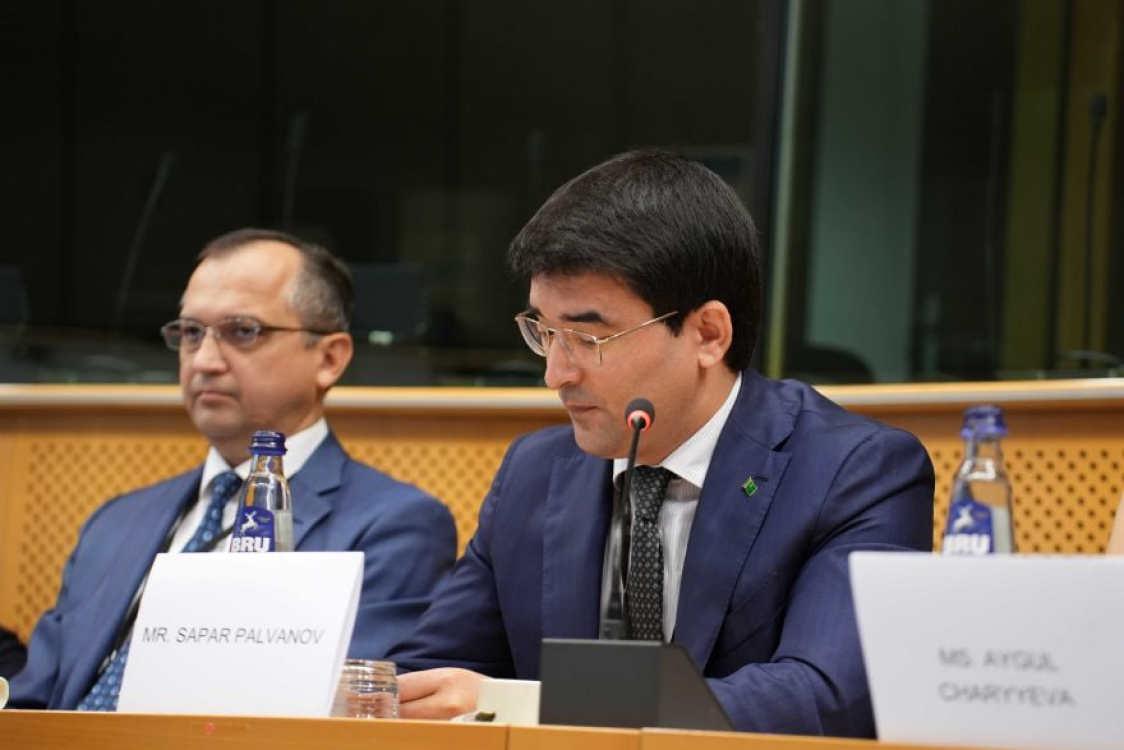
A high-level round-table discussion on the topic ‘The Trans-Caspian Corridor as a Factor in Strengthening the European Union’s Strategic Autonomy’ was held at the European Parliament in Brussels. The event took place with the support of Ilhan Kyuchyuk, Member of the European Parliament. This was reported by the press office of the Turkmen diplomatic mission.
Opening remarks were made by Ilhan Kyuchyuk, the Ambassador of Turkmenistan Sapar Palvanov, the Ambassador of Uzbekistan Gayrat Fazilov and the Ambassador of Kazakhstan Roman Vassilenko. The participation of representatives from Central Asia underscored the regional significance of the discussion and the shared interest in developing sustainable transport links between Central Asia and the European Union.
During his speech, Sapar Palvanov noted that, in today’s world, transport connectivity goes beyond a mere technical issue and is directly linked to the stability of supply chains, strategic autonomy and the diversification of routes. According to him, this also affects states’ ability to adapt to changes in the international situation.
The Ambassador emphasised that the Trans-Caspian transport route represents an additional strategic corridor for Europe, linking the European space with Central Asia and the wider Asian region via the South Caucasus and the Caspian Sea.
He also stated that, for Turkmenistan, this corridor forms part of the national transport policy. He said that the country’s geographical location presents both opportunities and responsibilities — to act as a reliable and predictable partner within the international transport system.
It was specifically noted that the Trans-Caspian Corridor should be viewed as a comprehensive transport ecosystem, encompassing ports, vessels, rail and road infrastructure, customs procedures, digital solutions, logistics companies and private-sector involvement.
Participants at the round table praised the route’s growing role in strengthening ties between the European Union, Central Asia, the South Caucasus and the wider Eurasian region. It was emphasised that the corridor is important not only for trade and logistics, but also for the resilience of supply chains and regional cooperation.
The programme included two panel sessions: ‘Central Asia and the Trans-Caspian Corridor: An Integrated Connectivity Architecture’ and ‘From Strategy to Investment: Global Gateway and EU-Central Asia Partnership’. The session was moderated by Derya Soysal, an expert on Central Asia and a PhD student at Tashkent State University of Oriental Studies.
During the discussions, the efforts of Central Asian countries to develop infrastructure, digitise procedures and strengthen regional coordination were highlighted.
Following the meeting, the need for further cooperation between the EU, the countries of Central Asia and the South Caucasus, international financial institutions and the private sector was emphasised. According to the participants, the development of the Trans-Caspian route should be based on specific projects, investments and digital solutions.
Read also
Advertising

 Read us in Zen


