


Koytendag remains one of the most remarkable natural regions of Turkmenistan. It is home to dinosaur footprints on high mountain plateaus, mountain caves and gorges — Daraydere, Tutlydere, Umbardere and Kyrk Gyz, an underground lake with blind fish, a grove of unabi trees and the highest point in the country — the Ayrybaba ridge. These sites attract travellers from Turkmenistan and other countries, according to the publication ‘Turkmenistan: Golden age’.
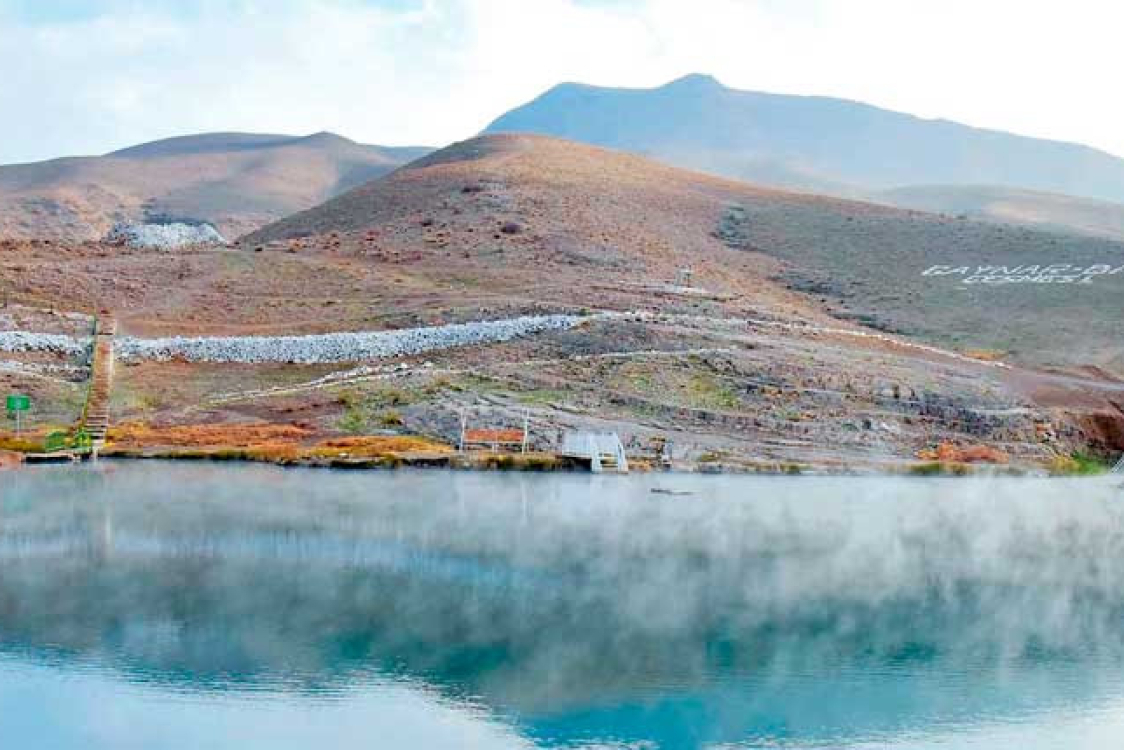
Among the region's natural attractions, the ‘Hojagaynar’ spring, known to locals as ‘Gaynarbaba’, stands out. It is located south of the village of Garlyk on the western slope of the mountain range.
The reservoir is about 40 metres long, almost 30 metres wide and up to three metres deep in places. The spring is formed by the confluence of two streams. One has clear water, while the other has a cloudy white tint due to its hydrogen sulphide content. Locals call them ‘ak suw’ (white water) and ‘gök suw’ (blue water). The name ‘Gaynarbaba’ is associated with the fact that the water coming out at the foot of the mountain visually resembles boiling.
Studies show that the water contains hydrogen sulphide, minerals and other chemical elements. Thanks to this, it is used in the treatment of skin diseases, digestive disorders and a number of other ailments. The water temperature remains at around 22°C all year round.
A distinctive feature of the spring is the presence of fish despite the absence of any connection to rivers or other bodies of water. According to experts from the scientific department of the Koytendag State Nature Reserve, the eggs may have been brought there by birds.
The fish swim freely towards people, as fishing is prohibited here and the place is considered sacred. There are no predatory species in the reservoir. Molluscs, earthworms and other invertebrates have also been found, which scientists consider to be ancient forms. For this reason, the spring is called a unique natural museum.
An endemic species of snail, Melania, measuring 3–4 centimetres, also lives here. These white shells with a speckled pattern are found nowhere else.
The ‘Gaynarbaba’ spring, like other sites in Koytendag, remains the subject of further scientific research.
Read also




Advertising




 Read us in Zen


