



The Turkmen people are among the ancient nations that have left a profound mark on the course of world history since early times. During the Middle Ages, Turkmens established states, khanates, beyliks, and atabegates not only within their historical homeland but also across various regions of Asia, Europe, and North Africa, playing a significant role in the political, economic, and cultural life of these territories. In that historical period, the Turkmen state of Kunya-Urgench emerged as one of the major centers that exerted considerable influence not only on the region itself but also on the cultural, economic, and political development of Southern and Central Asia.
Kunya-Urgench is located in the northern part of Turkmenistan, within the territory of Dashoguz velayat, near the ancient course of the Amu Darya River, and represents a unique center where ancient urban planning traditions and historical-architectural monuments are concentrated. The state of the Turkmen Khwarazmshahs (Kunya-Urgench) appeared on the historical stage following the decline of the Great Seljuk Turkmen Empire. Until the thirteenth century, the city served as the capital of the Khwarazmshah state. Although its foundation dates back to the eighth–ninth centuries, the period of its widest expansion and greatest prosperity occurred between the eleventh and sixteenth centuries. Beginning with the reign of Sultan Malik Shah, this center gained strength and gradually transformed into an important hub of trade and cultural exchange.
From the tenth century onward, Kunya-Urgench’s location along caravan routes passing through cities such as Urgench and Kichiurgench turned it into a major trading center between Asia and Western Europe. Cotton, textile products, wool, precious stones, and metal goods were produced here and exported to international markets. Its position at one of the key crossroads of the Great Silk Road further enhanced the city’s economic potential.
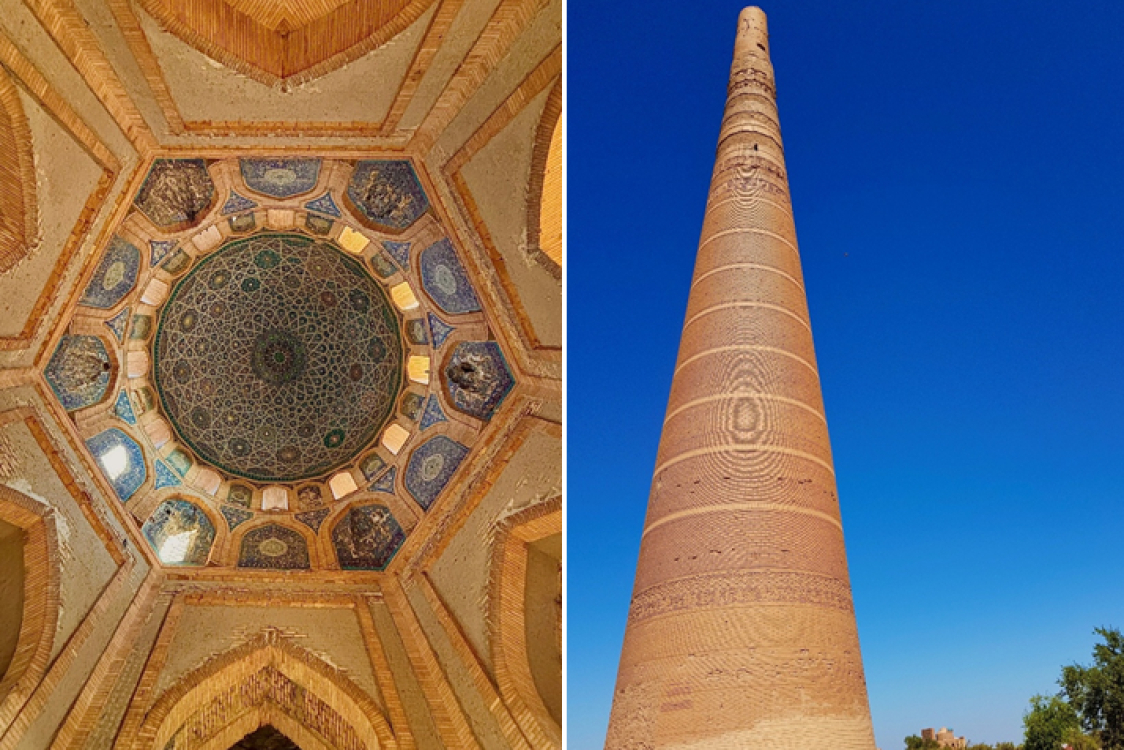
Kunya-Urgench is an integral part of the unparalleled cultural heritage of the Turkmen people and of humanity as a whole, being an ancient city that encompasses rare examples of Islamic architecture. Its domed mausoleums, madrasahs, and the harmonious composition of architectural structures reflect a high level of artistic mastery. In the Middle Ages, Kunya-Urgench was recognized as a major scientific, cultural, and economic center and was referred to as the “Heart of Islam.” Throughout its history, the city experienced periods of flourishing as well as severe destruction; nevertheless, its architectural monuments have survived as a unique artistic legacy passed down to the present day.
Culture and art occupied a special place in the state of Kunya-Urgench Turkmens. Historical sources particularly emphasize the hospitality, diligence, bravery, and strong civic engagement of the city’s inhabitants. In the fourteenth century, Urgench, through cooperation with the Golden Horde, achieved even greater cultural and economic development, leading to the establishment of madrasahs, libraries, and scientific centers. A clear testament to this is the Mamunid Palace, which, as a gathering place for scholars, came to be known as an “Academy.”
The architectural art of Kunya-Urgench was distinguished by advanced construction techniques and a high aesthetic level. In the domed mausoleums and madrasahs built during the thirteenth–fourteenth centuries, original architectural solutions were widely employed. The Mausoleum of Sultan Tekesh stands out in particular for its tent-shaped dome, square plan, and geometric ornamentation. The ribs integrated into the inner structure of the dome, the harmonious brickwork, and the use of blue-glazed bricks on the exterior surfaces attest to the high level of architectural craftsmanship of that era. At that time, architecture functioned not merely as construction activity, but as an important art form that united society in religious, social, and aesthetic dimensions.
Spiritual and religious heritage also held special significance in the state of Kunya-Urgench Turkmens. The mausoleums of Sultan Ali and Najm al-Din Kubra were recognized as important centers of learning, and religious art. These structures were created not only as burial sites, but also as comprehensive cultural and spiritual complexes, distinguished by their geometric ornamentation, decorative painting, and domed architecture. The integrated harmony of the city’s water management system, markets, and caravan routes transformed Kunya-Urgench into a strategically important center of trade, culture, and politics.
In 2005, Kunya-Urgench was inscribed on the UNESCO World Heritage List. This ancient city stands not only as a historical center of the past, but also as one of the significant cultural, political, and tourist symbols of Turkmenistan in the modern era. The preserved architectural monuments and caravan routes serve to present Kunya-Urgench to the world as the heart of the Great Silk Road.
Moreover, in October 2015, at a meeting of the Council of Foreign Ministers of the CIS countries held in Astrakhan, the city of Dashoguz in Turkmenistan was declared the “Cultural Capital of the CIS” for 2016. Based on this decision, the program “Cultural Capitals of the Commonwealth” was implemented in Turkmenistan. The program is aimed at strengthening cultural ties among the CIS member states, expanding cooperation, and creating favorable conditions for the development of economic and political relations.
Under the leadership of the President of Turkmenistan, Serdar Berdimuhamedov, and the National Leader of the Turkmen people, Hero Arkadag Gurbanguly Berdimuhamedov, the preservation, study, and promotion of historical and cultural heritage constitute one of the priority directions of state policy. In this regard, consistent efforts are being undertaken in world-significant historical centers such as Kunya-Urgench to restore architectural monuments, conduct scientific research, and present them at the international level. The measures implemented by the state not only ensure the protection of national heritage, but also further strengthen its place within the system of universal human culture.
Thus, the history of the Turkmen state of Kunya-Urgench has entered the annals not only as the history of an ancient polity, but also as that of a major center that made a substantial contribution to the cultural, artistic, and architectural heritage of Central Asia. This sacred land, which preserved the scientific traditions of great scholars such as Al-Biruni and Ibn Sina, continues today to attract the attention of international researchers and tourists alike through its distinctive architecture, economic potential, and historical role associated with the Great Silk Road.
Read also


Advertising




 Read us in Zen


