


In the contemporary era, the question of women’s place in society has ceased to be viewed solely as a social issue and has evolved into a significant component of strategic development, public governance, and international cooperation. Within the global political landscape, gender equality is recognized as one of the key prerequisites for economic growth, social stability, and sustainable peace. For this reason, recent years have witnessed a growing number of conferences, forums, and international dialogue platforms across various countries aimed at expanding opportunities for women. The international events held in Turkmenistan in 2025 – particularly the forums organized in Awaza – became a national reflection of this global trend.
The issue of women’s rights and opportunities today is largely shaped by economic factors. According to data from the United Nations, increasing women’s economic participation has a direct impact on the growth of gross domestic product. Academic research confirms that in the absence of gender equality, economic potential remains underutilized.
The Sustainable Development Goals adopted by the United Nations in 2015 included gender equality as a standalone objective (SDG 5). However, this goal is closely interconnected with other priorities, such as poverty reduction, quality education, healthcare, economic growth, and strong institutions. The achievement of these objectives is impossible without the active participation of women.
Observed annually on March 8, International Women’s Day, supported by the United Nations, serves not only as a symbolic celebration but also as a platform for reporting and strategic planning. In addition, the annual sessions of the Commission on the Status of Women (CSW) held in New York provide states with an opportunity to assess gender policies and adopt new commitments. The work of these international structures demonstrates that the women’s agenda is not an ideological or narrowly social issue, but rather an indicator of a state’s development capacity.
In Turkmenistan’s public policy, the role of women is developed in harmony with national values. A distinctive feature of this model is that gender equality is not viewed in opposition to traditions, but rather as a process grounded in them.
The International Forum ‘From Commitment to Change: Women Driving the Awaza Programme of Action,’ held in August 2025 in the ‘Awaza’ National Tourist Zone, was not merely an official event but a manifestation of the state’s strategic priorities. The discussions focused extensively on women’s economic opportunities, healthcare development, youth upbringing, and civic engagement.
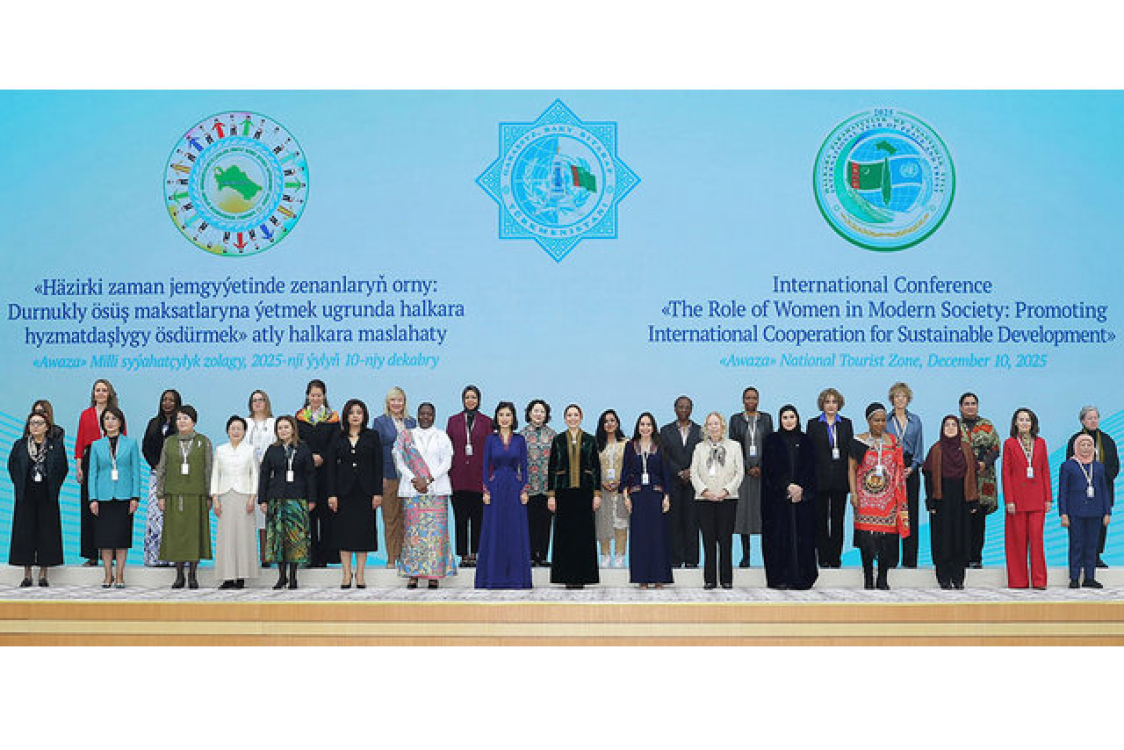
The events held on December 10 in Awaza further confirmed the systemic nature of this agenda. The International Conference titled ‘The Role of Women in Modern Society: Promoting International Cooperation for Sustainable Development,’ concluded with the adoption of a Final Declaration reaffirming commitment to the UN Charter, the Beijing Declaration and Platform for Action, and the 2030 Agenda for Sustainable Development. The document particularly emphasized the strategic role of women in social and economic development and in ensuring a sustainable future. Special attention was devoted to expanding women’s participation in public administration and civil society, developing their leadership potential, and strengthening the role of women’s organizations.
The Declaration also highlighted women’s economic empowerment, support for entrepreneurship, the reduction of the digital gender gap, and ensuring equal access for girls and women to quality education and healthcare. It underscored women’s contributions to science, culture, ecology, and the fight against climate change, as well as their importance in the development of human capital. The need to expand international cooperation, exchange best practices, and create new dialogue platforms was also emphasized. The regular organization of such forums throughout the year demonstrates that this work is systemic rather than episodic.
In 2024–2025, in cooperation with UN country offices, a number of projects were implemented to expand women’s economic opportunities, develop small businesses, and increase the participation of young girls in STEM fields. In this context, the advisory and analytical support provided by UN Women was of particular significance.
The growing attention to women’s role at the state level is not accidental but represents a strategic necessity shaped by a complex set of systemic factors.
First and foremost, this trend is directly linked to demographic characteristics. Women constitute a significant portion of the young population, and limiting their educational and professional opportunities may lead not only to social inequality but also to the underutilization of human capital. In a context where human capital is recognized as a key driver of modern development, restricting the potential of half the population hampers the full realization of a country’s intellectual, economic, and innovative capacity. Therefore, expanding women’s opportunities is not only a matter of social justice but also a crucial condition for a long-term development strategy.
The economic factor is equally important. International studies confirm that increasing women’s participation in managerial and leadership positions positively influences the quality of decision-making. Diversity of professional and social experience contributes to more comprehensive strategic planning, more accurate risk assessment, and the development of effective solutions. In an era marked by economic diversification, technological innovation, and enhanced competitiveness, the inclusion of diverse perspectives becomes an essential condition for sustainable growth. In this regard, expanding women’s economic activity should be viewed as a rational step aimed at increasing overall efficiency.
A third factor relates to international image and foreign policy dimensions. The level of gender equality development is included in various international rankings and analytical reports as an important indicator of a country’s progress. This criterion reflects not only the state of domestic social policy but also a country’s commitment to international obligations and modern development standards. Consequently, the gender agenda has become an important element of foreign policy positioning.
From the perspective of sociological theory, the role of women in society passes through three stages: traditional, transitional, and transformational. Today, many countries are in the transformational stage, where women are perceived not only as guardians of the family institution but also as full participants in economic and political life.
The Turkmen model seeks to harmonize transformational processes with national characteristics. Women retain their status as custodians of family values while simultaneously acting as active agents of social development. Such a dual model contributes to ensuring social stability.
Today, the strategic role of women in social development is viewed not merely as an issue of equal opportunity but as a fundamental condition for long-term national development and international authority. The digital economy, ‘green’ growth, and the transformation of the education system all require the participation of highly qualified and active women. Therefore, the systemic measures undertaken in this direction demonstrate the modern and comprehensive nature of Turkmenistan’s development strategy.
Read also
Advertising

 Read us in Zen


